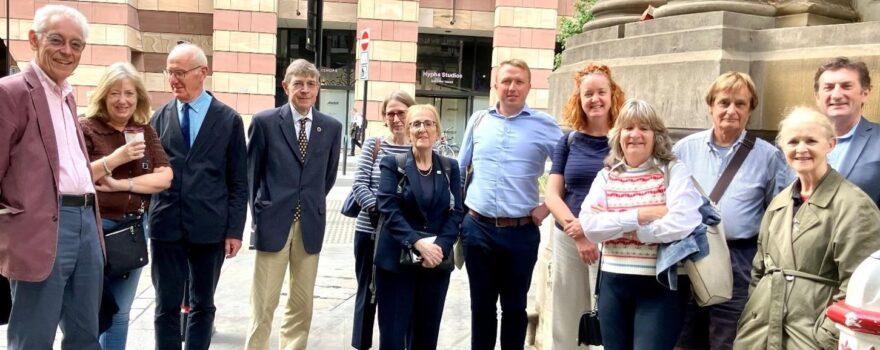
LCAG led by Alderman Alison Gowman meeting at Bucklersbury on 15 September 2026 with Tim Munday, (Lead Environmental Resilience Officer at the City of London Corporation)
For ‘Urban Drainage’ think ‘Rain Garden’. This is a much more appealing term that captures the simple principle of rain falling onto the garden and being captured in the soil/substrate. Led by Tim Munday, the City of London is Developing City Gardens to replicate this natural process. Rain Gardens have the design feature of capturing water running off hard-standing areas so that it is retained in the planting and substrate materials and in some cases in tanks beneath the planting. This creates oases of coolness and biodiversity.
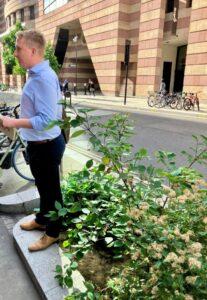
Rain Garden in Queen Victoria Street
This example on the left shows one of an increasing number of Rain Gardens which absorb water running off from the pavements by filling up the planting medium and the tank beneath through a partially disguised grill. If the tank reaches maximum capacity, the water then flows into a perforated ‘French pipe’ which slowly redirects the water into the sewers. This water management process is helping to reduce London’s surface water flood risk.
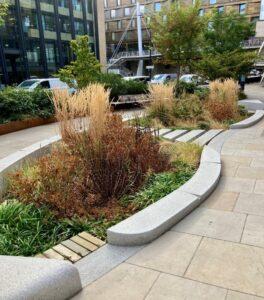
Rain Garden in Garlick Hill
The Rain Garden on the right receives rain water flowing from paved slopes via the curved inlets, and the brickwork fans the water into the wider garden. Its garlic-clove shape is a nod to its St James Garlickhythe location in Garlick Hill.
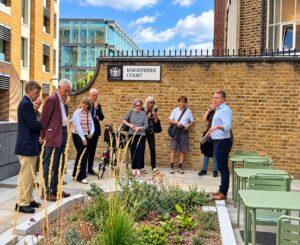
Rain Garden in Knightrider Court
Another Rain Garden in Knightrider Court (left) is a powerful example of the work and effort that goes into creating these gardens from scratch: tarmac was lifted, a one metre trench was dug, a tank was installed, large blocks of ‘Hydrorock’ were installed at 80% water absorption for planting but mainly to minimise flooding from pavement run-off in an attractive way. This is one of 5 similar Rain Gardens in London.
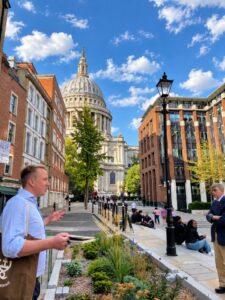
Looking up to St. Paul’s Cathedral
All of these Rain Gardens contribute to fulfilling the 10 years’ long City Plan for the management of surface water and sustainable drainage. Currently 11% of the City (31 hectares equalling just over 44 football pitches) is managed in line with the Plan and this work is continuing. Runoff rates and sewer capacities are constantly monitored.
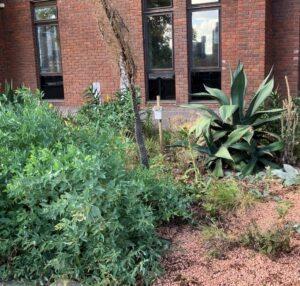
City of London School Paul’s Walk
‘Desert-style’ planting for drought conditions was adopted as an experiment in 2022 and is exemplified in the photograph (left). It was watered only four times throughout the two hot, dry summers in 2025 and 6. The bed is fitted with moisture sensors and there is a ‘false’ osmosis-type layer of planting material that traps water.
Note the insect monitor that audio records the buzzing of insects, allowing identification and monitoring of pollinators.
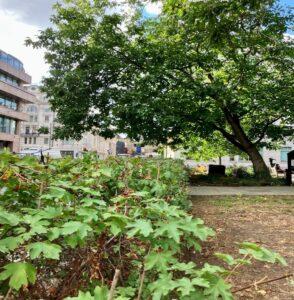
Whittington Gardens, College Street
‘A Green Corridor’ is a conduit that gives shade and biodiversity of both planting and pollinator habitats. The hedge (completed in 2023 in Whittington Gardens, College Street) shown in the photograph to the right comprises a variety of planting (eg hawthorn, hazel and blackthorn) providing seasonal food to support wildlife and has a variety of cultivars so being more resilient to diseases than a single species.
We should note that ‘Green Corridors’ can have sections at various heights including on roofs.
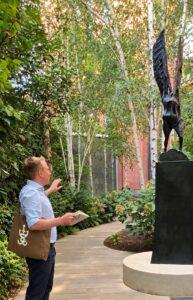
Distaff Lane Garden
A cool oasis in Distaff Lane Garden is this birch grove, planted six years ago and shown in the photograph to the left. It provides necessary shade, oxygen and CO2 absorption for a 24-7 City.
‘Lost/hidden rivers/forgotten streams’ are more appealing terms than sewers, but this is the status of the Walbrook river, lost for approx. 800 years and paved over in the 1200s. There are other similar lost rivers that are essentially part of the sewer system (Fleet, Effra, Tyburn).
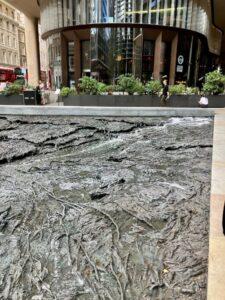
Installation outside the Bloomberg Building, Walbrook
Under the installation to the right outside the Bloomberg Building in Walbrook is a huge tank of water which feeds a circulating flow which is topped up when necessary.
In this area of high development there is a need for a water feature to help reduce over-heating and also to capture surface water so that it can’t cause flooding. This type of installation traps water and is a managed pool of water for controlling and pushing through liquid waste into the sewer system.
‘Lost river’ water does not drain directly into the Thames but is captured on a big floating ramp and then goes in to a great big portal carrying it into a ‘Super Sewer’. This grey water/sewage management is part of the Thames Tideway: a water-quality project. The success of the project is evidenced by there being fewer ‘treasures found’ on the foreshore of The Thames for mud larkers and as many as 52 varieties of fish caught and thrown back from the river at Denton.
There are four pillars of the City of London’s water strategy, its quantity, quality, biodiversity and recreational offering: the examples in this report show specific examples of how this strategy is delivering against its targets.
Anne Punter, LCAG Executive Member