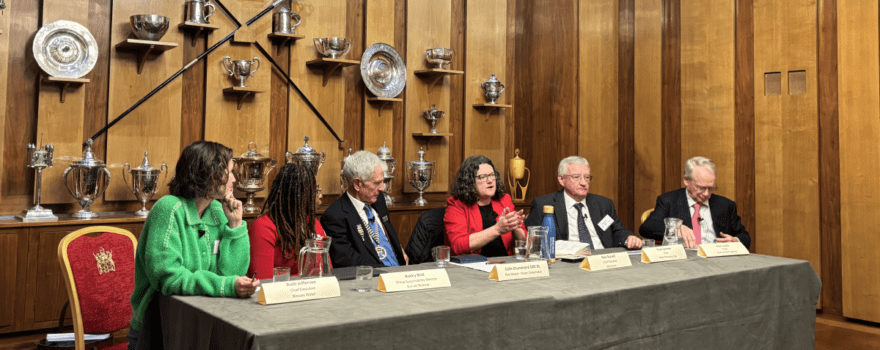
The Worshipful Company of Water Conservators held their annual Water Debate at Bakers’ Hall and we have the benefit of being able to print their news release update provided by their Livery Member, Nick Higham.
England needs “complete behavioural change at national level” from water users if it is to meet the challenge posed by a predicted shortfall in the public water supply of 5 billion litres per day by 2055. But Britain’s water industry has done a “dismal job” of explaining the issue to customers, and it’s not clear where the necessary leadership and co-ordination will come from, according to speakers from across the sector at the annual City Water Debate.
The principal speakers were Alan Lovell, chair of the Environment Agency; Ruth Jefferson, chief executive of Wessex Water; Bukky Bird, group sustainability director at housebuilders Barratt Redrow; Paul Leinster, chair of Water Resources East; and Nicci Russell, chief executive of the water efficiency and conservation organization Waterwise. The debate was held under the Chatham House rule.
The UK is already abstracting more water from the environment than is sustainable: the debate addressed the question – often overlooked in the current controversies about the water industry and sewage pollution – of how to tackle the shortfall, which is a consequence of factors including climate change and population and economic growth.
The debate was told the Environment Agency believes part of the answer is “demand management” – getting consumers to use 2.5 billion litres per day less water, alongside measures to reduce water company leakage (saving 0.9 billion litres) and investment in new infrastructure like reservoirs and desalination plants (saving 1.7 billion litres).
Customers were willing to take action to reduce water consumption when the issue of scarcity was explained to them, according to one speaker, but several contributors to the debate questioned whether the water sector was communicating its water efficiency message clearly enough or consistently enough to change behaviour. Hosepipe bans were welcome, because they offered one of the few opportunities to put the message across.
One veteran observer of the water sector observed that there had been water efficiency campaigns since the 1990s but they had made little progress. Persuading people to change their water use – to “do stuff that’s difficult” – was made more challenging by lack of consumer trust in both water companies and government.
And the water sector itself was accused of failing to put water efficiency at its heart.
The debate also heard, amongst other things, of the need to retrofit existing housing stock to make homes more water efficient, of the need for greater rainwater reuse, and of the importance of smarter planning systems. At present, planning for housing growth and water resources are not aligned, and water companies are not allowed by Ofwat to incorporate predictions for future housing growth in their investment plans.
The problem is particularly acute in the East of England, where a combination of rapid planned population growth, low rainfall and increasing nitrate levels in regional water resources present particular challenges.
There were calls for improvements in regulation and greater co-ordination between the different sectors involved – including farmers, housebuilders, local authorities as well as water companies.
Our LCAG attendee felt that there was some refreshing candour and positivity both from the panel and the attendees. The Water Conservators continue to address the big issues of today and find compelling topics and people to debate them.