
Online Seminar by Colonel David Bates, LCAG representative for the Worshipful Company of Nurses
“Greener health” has become a familiar phrase, but the ideas behind it have been evolving for decades. Today, it sits within a broader understanding that human wellbeing, environmental stability and social resilience are deeply interconnected. Looking back at how this thinking developed helps explain the choices now facing public health, the City and the Livery movement.
Healthcare’s Environmental Footprint
While greener health often refers to public health more broadly, the environmental impact of healthcare systems remains an important starting point.
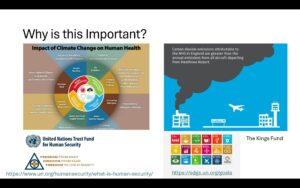
Analysis from the King’s Fund in 2012 (Ref 1) estimated the annual NHS carbon emissions exceeded those generated by all aircraft departing from Heathrow Airport. Most of the NHS footprint stems from buildings, logistics, energy use and clinical supply chains.
The NHS has set out plans under its sustainability programme, but many of these actions still appear incremental rather than transformative. Yet reducing the sector’s emissions is more than an environmental imperative. Good health underpins social stability and even global security. As recent conflicts and crises remind us, when health systems fail, wider systems begin to fracture.
How Greener Health Evolved
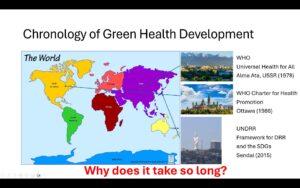
These efforts laid the groundwork for today’s planetary health approach, which acknowledges that human health depends on ecological stability.
The Wider Determinants of Health
Public health has long recognised that clinical care explains only a small part of health outcomes. The “rainbow model” highlights the roles of education, housing, water systems, planning, architecture, culture and economics. When these elements lose coherence, communities face disease, inequality or instability.
Prevention remains key. Investing in upstream action—healthy environments, resilient communities, thoughtful planning—delivers far greater value than responding once people reach hospital. Encouragingly, this thinking continues to feature in discussions across local government.
The City, the Livery and a Changing Landscape
The City’s historic resilience—through plague, fire, war and reconstruction—offers a useful reminder of its capacity to adapt. During the COVID-19 pandemic, the then Lord Mayor, William Russell, issued a call to action on climate and health that many in the Livery movement have embraced through their Companies or collaborative networks, notably LCAG.
Yet the global context is becoming more challenging. Recent political decisions in the United States risk reversing progress in global health equity, particularly for low-income countries. Gains that took decades to achieve can be quickly undone, underscoring the need to protect and advance greener health principles.
From One Health to Planetary Health
The evolution toward planetary health reflects earlier frameworks:
- One Health, which aligned human, animal and environmental health.
- Global Health, which drew attention to transnational risks and inequalities.
- Planetary Health, which integrates climate science, ecological limits and human wellbeing.
The message is straightforward: neither health nor environmental stability can be addressed in isolation.
Embedding Greener Thinking
Meaningful progress depends not just on technical solutions but on attitudes and culture. Public health requires creativity, breadth and engagement with communities. Recent planning decisions—including ecology-focused development orders—are small but positive signs of greener thinking becoming embedded in routine practice.
The Worshipful Company of Nurses will publish its Climate Action Plan following approval at the January 2026 Court meeting. It represents another step toward supporting a healthier and more sustainable future.
See the full online seminar on LCAG’s YouTube Channel.
Edited by Gordon Masterton, Past Master Engineer and LCAG Executive member,
[derived from an AI-generated draft blog of the recording transcript]